| + | Tuesday, 15 October 2013 |
Making Essential Oil
Today we made essential oil! We extracted D-Limonene from orange peel, which is an essential oil that has anti carcinogenic properties and is also used in numerous cleansing products. Using fruit peels is good for the environment, as the peels are usually discarded after consumption, and this is a form of reusing the peels.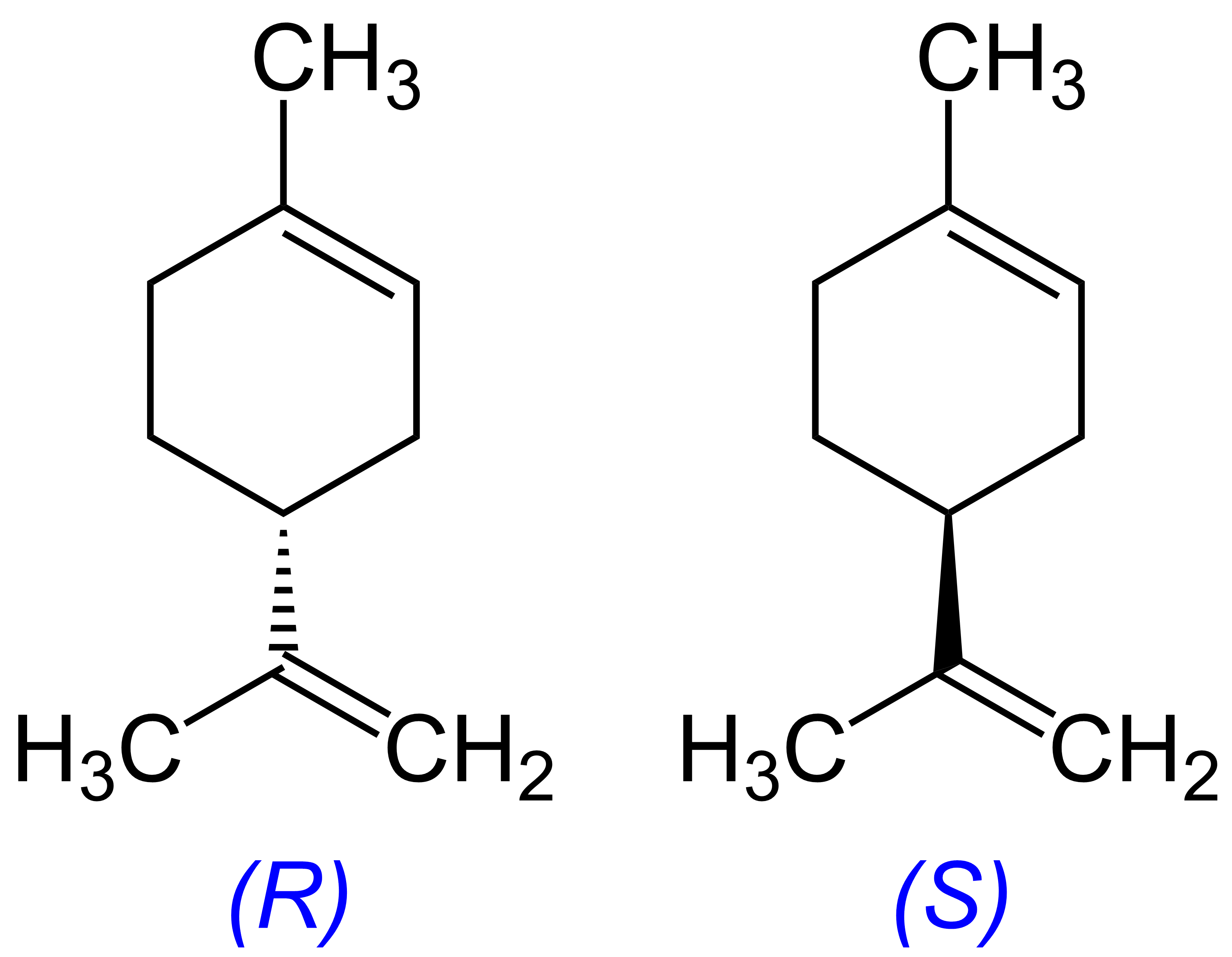
Fig 1. The two commonly found isomers of Limonene, D-Limonene and L-Limonene. D-Limonene smells like citrus.
The primary method of extraction is through steam distillation, which is the oldest form of essential oil extraction. The process does not denature the structure of D-Limonene. Hot steam opens the pockets in which the oils are kept and release D-Limonene from the fruit peels.
To extract D-Limonene from orange peel, we first cut out only the coloured part of the peel of an orange into a beaker. Distilled water was added to the orange rind and the mixture was transferred to a blender to blend everything up. We then transferred the blended orange rind mixture to a flask and placed the flask on a hot plate to heat it up. We then set up the steam distillation apparatus as shown below.

Fig 2. A sample steam distillation setup.
As the mixture boils, water is lost from the distillation mixture and a mixture of water and D-Limonene is eventually collected. We transferred our yield to a three boiling tubes and placed them in a water bath for 5 minutes to remove extra water. Finally, using a dropper, we transferred the layer of D-Limonene on top to a small tube to store.

Fig 3. Our steam distillation set up; on the right is the distillation mixture of water and blended orange rind, on the left is our yield.
We obtained very little D-Limonene, however, our purity was high as the D-Limonene separated very well even prior to placing it in a water bath and it was very fragrant. Our group did not add much water to the distillation mixture, hence it took a while to boil and our yield was low, but this meant that purity was high.
| + |
Making Biodiesel from Vegetable Oil and Fuel Efficiency
Today we made biodiesel from vegetable oil. Our group decided to use corn oil.Basically, vegetable oil undergoes a process called transesterification to become biodiesel. In transesterification, one ester is transformed into another ester in the presence of a catalyst such as concentrated sulfuric acid or sodium hydroxide.

Fig 1. R' group and R'' group are exchanged with each other. R' and R'' denote an alkyl or aryl group.
We first found out the vegetable oil, although it is an oil, could not be used as fuel for a car as the molecules are too large and hence it is not efficient. (Vegetable oil molecules are 3 times as large as biodiesel molecules!) The vegetable oil molecule is a triglyceride, meaning there is a glycerol with 3 fatty acids.

Fig 2. A vegetable oil molecule is a triglyceride, made up of one glycerol and three fatty acids.
A biodiesel molecule, however, is smaller and hence much more efficient and can be used as fuel. The product, in this case, is methyl pentadecane.

Fig 3. A biodiesel molecule is smaller than a vegetable oil molecule.
Armed with information on the chemistry of the reactions, we embarked on our journey in making biodiesel!
We measured, weighed and heated corn oil in a conical flask on a hot plate, adding methanol and 0.1M sodium hydroxide in 8 intervals of 5 minutes each. We had to make sure that the temperature of the oil did not go above 70-80 degrees Celsius as it would boil over.


Fig 4. Making biodiesel: heating the oil on a hot plate and measuring temperature with a thermometer.
Next, we added acetic acid to the mixture to help separate the glycerol (which we do not want) from the biodiesel (which we want). We then transferred this to a separating funnel and discarded the lower layer, which is that of the denser glycerol, and poured the layer of biodiesel into a conical flask, measuring our yield.

Table 1. Table showing initial mass of corn oil and final mass of biodiesel.
We tested the effectiveness of different fuels - methanol, cyclohexane and our biodiesel.
To test the effectiveness, a small wad of cotton wool is placed in a crucible. 10ml of methanol is measured using a measuring cylinder and poured onto the cotton wool in the crucible. Measure 100ml of water into a beaker and record initial temperature. Place the beaker on a retort stand. Using the flame from a bunsen burner, we lit up a wooden splint and used it to set fire to the fuel. We then shifted the beaker of water above the flame and heated it up for 3 minutes. The final temperature of the water was recorded. Repeat the entire procedure with cyclohexane and biodiesel.
Whilst the experiment yielded results when using methanol and cyclohexane, our biodiesel did not manage to work. We suspect it is due to too much water inside the biodiesel. However, the flame did not extinguish immediately, meaning that there is still some biodiesel inside, but the purity is not high enough (i.e. there is too much water) so the a fire cannot be sustained. Hence, there are no results for biodiesel.

Table 2. Table showing final and initial temperature of water when heated using 10ml of cyclohexane and 10ml of methanol.
To determine the efficiency of cyclohexane and methanol, we did the following:
First, we found out the mass of fuel used by multiplying density x volume. Then we found the heat supplied to the water, Q, by using the equation Q=m x c x change in temperature. Efficiency was calculated using the equation heat supplied / moles of substance.
Mass of methanol = 791.30 x 0.01 = 7.913
Qwater = 0.01 x 4.181 x (100.0-31.0) = 2.8849
Efficiency of methanol = 2.8849 / (7913/32) = 11.7 kJ/mol
Mass of cyclohexane = 779.0 x 0.01 = 7.79
Qwater = 0.01 x 4.181 x (75.0-31.0) = 1.8396
Efficiency of cyclohexane = 1.8396 / (7.79/86) = 20.3 kJ/mol (3 sf)
Hence, the conclusion is that cyclohexane is more efficient than methanol as a fuel.
| + | Sunday, 29 September 2013 |
Sustainability and Making Bioplastic from Casein
We started off our Green Chemistry options module with learning about what exactly is Green Chemistry. Green Chemistry, also known as Sustainable Chemistry, is in essence about using environmentally friendly methods to reduce pollution and minimise our impact on the environment.Our first group activity was to present on a company's sustainability agenda and what have they done/what are they doing to reduce environmental impact. For our group, we chose Justin's, which is a company based in Boulder, Colorado that manufactures nut butters. They're a very environmentally conscious brand, always seeking ways to reduce the amount of plastic and paper they use, sourcing for local ingredients to minimise carbon emissions from transport etc.
Our practical session involved making bioplastic from carbohydrates. By mixing corn flour or potato starch with some corn oil, water and food colouring and then microwaving it, we could produce a plastic that, while was not strong and would dissolve in water, was environmentally friendly and fully biodegradable. By mixing the correct amounts of oil with starch, we could convert the amylopectin (which is branched) to amylose (which is not branch), thus conferring a proper structure to our plastic. My own products were not very well-formed because I didn't use the proper amounts of corn oil, water and food colouring; I added too much water, resulting in a very sad-looking plastic.
The next practical session focused on making bioplastic from protein. This time, we mixed milk with ethanoic acid (vinegar) and heated it up to 50 degrees C.
As we heated up the mixture, the milk started to smell very sour and unappealing, and solid curds began rising to the surface.

Fig 1. The solid curds rising!
Once that happened, we filtered the mixture to obtain the residue, which we then molded into our desired shape. (A ball.)

Fig 2. Our masterpiece.
We did a little research and found out that this was actually the same method many people use to make cheese! The combination of vinegar and milk is also used by many people in baking as a substitute for buttermilk.
Basically, this bioplastic that we produced is from casein, which is a kind of protein found in milk. It is a protein suspended in collodial solution, meaning that they repel each other. When vinegar was added, the pH is lowered, the negative charges of casein are neturalised and these casein molecules attract instead of repelling each other. The casein molecules then unfold and reorganise into a long chain, hence 'curdling' the milk.
This 'curdling' is possible as protein has various levels of structure - primary, secondary, tertiary and quarternary. In the primary structure, peptide bonds within the protein molecules are visible; in the secondary structure, hydrogen bonds between protein molecules are visible; in the tertiary structure, disulfide bonds between chains of protein molecules are visible; and in the quarternary structure, the overall shape of the protein is visible.